

Walk into any home lift showroom in Malaysia and you will encounter a familiar experience: a salesperson eager to move you toward the highest-margin model, a brochure full of feature names that sound impressive but lack context, and a pricing structure that raises more questions than it answers. Most homeowners leave more confused than when they arrived — and no closer to a decision.
The challenge is that choosing the best home lift for houses requires a framework, not a sales pitch. The right air-driven home lift for a two-storey terrace home with two ambulatory adults and occasional elderly parents is a fundamentally different product from the right lift for a four-storey bungalow with a wheelchair-dependent family member and daily high-frequency use. Applying the same generic recommendation to both situations is how homeowners end up either over-investing in capacity they never use or under-investing in features they should have had from day one.
This guide provides the decision framework. It works through the four key variables systematically — space, users, floors, and budget — then explains how to map those variables to specific model choices within the Malaysian air-driven residential elevator market. Follow it and you will arrive at a clear, confident recommendation for your specific home.
Variable 1: Available Floor Space — The Starting Point
Floor space is the first and most constraining variable. All other decisions flow from what space your home can offer. Air-driven home lifts come in two footprint categories:
Standard Models — From 1,000 mm Clear Space
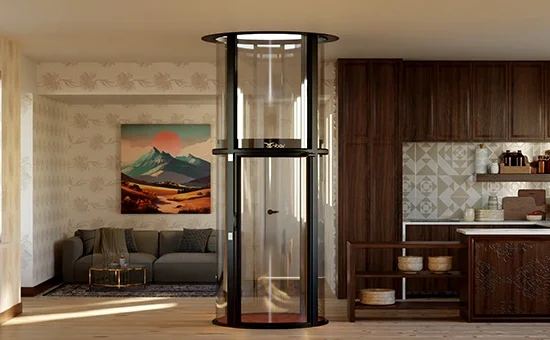
Standard models have an external cylinder diameter of 933 mm and require a minimum of 1,000 mm (1,010 mm for Series III) of clear floor space. This is the most compact residential lift footprint available in Malaysia and fits the majority of two and three-storey terrace houses, semi-Ds, and townhouses. The internal cabin diameter is 749 mm (Series III) to 830 mm (Series IV and V), suitable for 1 to 2 ambulatory passengers.
Max Models — From 1,430 mm Clear Space
Max models have an external cylinder diameter of 1,363 mm and require 1,430 mm of clear space. The internal cabin diameter is 1,240 mm — large enough for a wheelchair user and an attending family member travelling together. If wheelchair access is a current or anticipated future need, the larger footprint is non-negotiable.
Before requesting a single quote, measure your available space in the most likely installation locations: stair voids, hallway corners, lightwell spaces, and ground-floor living area corners. If your maximum clear space is between 1,000 mm and 1,430 mm, a Standard model is your only option. If 1,430 mm or more is available, both categories are accessible.
Variable 2: Who Will Use the Lift Most?
The primary users of the lift determine both the minimum cabin requirement and the safety feature priorities. Think through every regular user:
Ambulatory Adults and Children
If all regular users walk independently, a Standard model is fully sufficient. The 210 kg weight capacity comfortably handles 2 adults and is designed for daily family use. Standard safety features — triple-layer door locking, child safety lock, overload alert, emergency descent — protect all user types.
Elderly Residents
For elderly users who walk with difficulty but do not use a wheelchair, a Standard model works well. However, consider upgrading to auto-opening doors (AutoGlide, available on Series V) — the ability to enter and exit the cabin without manually operating a door makes a meaningful practical difference for arthritis sufferers and those with limited grip strength.
Wheelchair Users
A wheelchair user with an attending family member requires the Max cabin (1,240 mm internal diameter, 240 kg capacity). This is a firm requirement — attempting to use a Standard cabin with a wheelchair creates a safety risk and fails to meet the accessibility standard the user deserves. Max models are available from Series III Max upward at prices from approximately MYR 1,09,900.
Variable 3: Number of Floors and Travel Height
All air-driven residential elevator models in Malaysia support up to G+3 (4 stops) with a maximum travel height of 13,500 mm. For the vast majority of Malaysian residential properties — including large bungalows and multi-storey villas — this is more than sufficient.
What varies with floor count is pricing:
- G+1 (2 stops): The most affordable configuration — appropriate for standard two-storey terrace homes and the majority of Malaysian compact duplexes.
- G+2 (3 stops): Mid-range pricing — covers three-storey properties, which are increasingly common in Klang Valley and Johor developments.
- G+3 (4 stops): Full range pricing — appropriate for four-storey bungalows, large villas, and properties with a rooftop terrace or mezzanine level.
If you are currently in a two-storey home but planning a future extension, discuss this with your supplier during the site assessment. Some configurations allow for future stop additions without replacing the core lift unit.
Variable 4: Budget — Mapping Your Requirements to a Model
With your space, user, and floor variables established, budget becomes the final matching variable. Here is how to choose an air-driven residential elevator within each price tier:
MYR 69,900 to MYR 1,00,000 — Essential Accessibility
Series III Standard. Best for: compact terrace homes, first-time buyers, practical accessibility needs, value-focused families. Delivers: 210 kg capacity, 4 stops, 14+ colour options, CE and TÜV NORD certification, full emergency safety systems. What it lacks: smart features, auto-opening doors, premium finishes.
MYR 1,00,000 to MYR 1,40,000 — Smart and Spacious
Series IV Standard or Max. Best for: modern homes with smart home integration, families needing wheelchair access, homeowners who want advanced features at mid-range pricing. Delivers: AI and voice control readiness, frameless doors, 24+ finishes, Grease Less Technology. Series IV Max adds a wheelchair-accessible cabin at MYR 1,36,900.
MYR 1,40,000 and above — Luxury and Legacy
Series V Standard or Max. Best for: premium bungalows, luxury interior integration, homeowners who want a lift that defines the home. Delivers: AutoGlide auto-opening doors, HeartLine personalised engraving, SkyMark illuminated ceiling, ZeroTrace seamless panels, VividTouch display, 25-year CoreShield warranty. Series V Max adds wheelchair access at the highest standard.
The Decision Checklist: Finding Your Ideal Lift
Run through this checklist to arrive at your model recommendation:
✓ Measure available clear space — Standard (1,000 mm+) or Max (1,430 mm+)?
✓ Identify primary users — ambulatory only, or wheelchair access needed?
✓ Count floors to serve — G+1, G+2, or G+3?
✓ Set a realistic total budget — including no civil construction costs for air-driven lifts
✓ Confirm smart home integration needs — voice control, app control, touchscreen display?
✓ Consider future needs — wheelchair access in 10 years? Additional floors planned?
✓ Request free site feasibility assessment — confirms exact space availability
✓ Visit experience centre — ride the shortlisted models before deciding
The right air-driven residential elevator for your house is the one that matches your actual space, your real users, your genuine floor requirements, and a budget that reflects the true all-in cost — not just the headline unit price. Armed with this framework, that decision is significantly more straightforward than most first-time buyers expect.
Frequently Asked Questions
1: What is the best air-driven home lift for a standard Malaysian terrace house?
For a standard two-storey terrace house with ambulatory adult users, the Nibav Series III Standard or Series IV Standard offers the best balance of compact footprint (1,000 mm clear space), practical features, safety certification, and value. Start from MYR 69,900 with no civil construction costs.
2: How do I choose between a Standard and Max model home lift?
Choose Standard if all regular users are ambulatory and floor space is limited to 1,000 mm to 1,429 mm. Choose Max if wheelchair access is needed, you have 1,430 mm or more of clear space, and a larger, more comfortable cabin for daily multi-person use is the priority.
3: Can I install a home lift in an existing house without major construction?
Yes. Air-driven, self-supporting, pitless lifts require no pit, no machine room, and no structural changes. Installation takes 4 to 5 working days and only requires circular floor openings at each level served — carried out cleanly by the installation team.
4: Should I choose a home lift with auto-opening doors?
Auto-opening doors (AutoGlide) are strongly recommended for households with elderly users, wheelchair passengers, or anyone with limited grip strength. For younger, fully mobile households, manual doors are functionally adequate. The difference in daily experience is significant for elderly and mobility-impaired users.
5: How long does the decision-to-installation process take?
From first contact to installed lift, the typical timeline is 2-3 weeks— including site assessment, order confirmation, Suppliers with strong local teams can sometimes compress this for urgent needs.
