
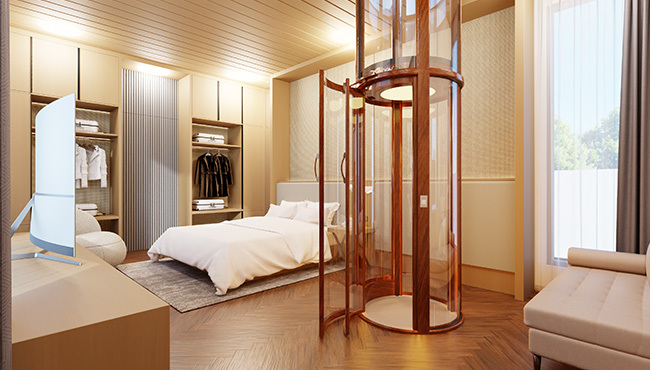
You’ve seen the photos: a sleek, transparent cylinder rising smoothly through a home with no visible cables, no engine room, no obvious machinery at all. It looks almost like magic, and that’s exactly the problem. When something looks too simple, it’s natural to wonder what’s actually happening inside, and whether it’s genuinely as safe and reliable as it looks.
That uncertainty holds a lot of people back from taking a vacuum home elevator seriously, even when the idea appeals to them. Without understanding the actual mechanism, it’s hard to trust a piece of equipment that will carry your family members between floors every single day. Vague marketing language like “air-powered” or “vacuum technology” doesn’t help much if you don’t know what’s physically happening inside that cylinder.
The reality is refreshingly straightforward once it’s explained properly. A vacuum home elevator relies on a well-understood physical principle, air pressure differential, applied through carefully engineered components. This guide breaks down exactly how it works, piece by piece, so the technology stops feeling like a mystery and starts feeling like something you can genuinely evaluate.
The Core Principle Behind a Vacuum Home Elevator
At its simplest, a vacuum home elevator moves using air pressure rather than cables, pulleys, or hydraulic fluid. The cabin sits inside a sealed, self-supporting cylinder. To move upward, a turbine at the top of the cylinder draws air out from above the cabin, creating a zone of lower pressure. The higher air pressure beneath the cabin then pushes it upward, in exactly the same way pressure differences work in countless other everyday physical systems.
To descend, the process simply reverses. Air is gradually allowed back into the upper chamber, equalising the pressure, and gravity brings the cabin back down in a smooth, controlled motion. There’s no need for a counterweight system or a continuously running motor pulling against gravity, the cabin essentially glides down using the same principle that lifted it up.
It’s worth pausing on just how few components this actually requires compared to what most people picture when they imagine elevator machinery. There’s no engine room stacked with pumps and hydraulic reservoirs, no heavy counterweight suspended on cables, and no gearbox translating rotational motion into vertical lift. The entire system is contained within the cylinder itself, which is precisely why installation looks so different from a traditional elevator.
Vacuum Elevator Malaysia Homes Use: Why the Sealed Cylinder Matters
The sealed, self-supporting cylinder is the component that makes this technology genuinely practical for residential use in Malaysia. Because the entire mechanism is contained within this single structure, there’s no need for a separate shaft built into your home’s walls, no pit dug below floor level, and no machine room to house additional equipment elsewhere.
This cylinder is engineered to be structurally independent, meaning it doesn’t rely on your home’s existing walls for support. That’s what allows installers to position a vacuum elevator Malaysia homeowners choose almost anywhere with adequate floor space, a stair void, a corner, or even against an exterior wall, rather than being constrained to wherever a traditional shaft happens to already exist.
How a Pneumatic Elevator Malaysia Suppliers Install Controls Speed and Safety
Speed and safety in a pneumatic elevator are managed through precise control of air flow rate, not by simply switching power on and off abruptly. Valves regulate exactly how quickly air is drawn from or released into the upper chamber, which translates directly into smooth, gradual acceleration and deceleration rather than sudden jolts.
This same air-based system also plays a role in safety. If normal operation is interrupted, such as during a power failure, releasing the vacuum allows the cabin to descend gently under a controlled process rather than dropping suddenly, since gravity combined with regulated air release naturally produces a gentle rather than abrupt motion.
What Makes an Air Driven Home Lift Different From Older Elevator Technology
Traditional elevators rely on either a hydraulic piston pushing against pressurised lubricant or a motor-driven cable and counterweight system, both of which are mechanically more complex and require significantly more supporting infrastructure. An air driven home lift replaces most of that complexity with a single, elegant mechanical principle applied through a compact, self-contained cylinder.
This simplicity has real, practical consequences beyond just installation. Fewer moving mechanical parts generally means less that can wear out or fail over time, and the absence of hydraulic fluid removes a common source of leaks and long-term maintenance issues that affect older lift technologies.
Common Questions About How Vacuum Home Lift Technology Performs Day to Day
People considering a vacuum home lift for the first time often ask the same practical questions once they understand the basic mechanism. How much power does it actually use? Primarily during ascent, since descent relies mainly on gravity and controlled air release, which tends to keep running costs modest.
Is it noisy? Generally no, since there’s no clanking chain, cable, or hydraulic pump running continuously, just a turbine operating briefly during ascent. And is it reliable in Malaysia’s humid climate? Reputable models use corrosion-resistant materials and sealed components specifically engineered to handle sustained tropical humidity without degrading over time.
One more question worth addressing directly: does the technology require any special maintenance most homeowners wouldn’t anticipate? Generally, servicing focuses on checking seals, the turbine motor, and safety sensors periodically, rather than anything unusually specialised. Most reputable suppliers include this as part of a standard maintenance schedule rather than treating it as an unpredictable, ad hoc cost.
Why Nibav’s Air-Driven Technology Is Engineered for Malaysian Homes
Nibav’s vacuum home lifts apply this air-pressure principle through a precision-engineered, self-supporting cylinder built specifically to handle Malaysia’s climate and typical residential floor plans. Every model is TÜV NORD certified, meaning the underlying mechanism, not just the finished product, has been independently verified against recognised international safety standards.
With over 10,000 installations completed and a physical experience centre in Kuala Lumpur, Nibav gives homeowners the chance to see this technology in operation firsthand, rather than relying purely on an explanation.
What Sets Nibav’s Vacuum Technology Apart
Nibav’s turbine and valve systems are calibrated for smooth, whisper-quiet operation, while precision landing technology ensures the cabin settles exactly flush with each floor despite relying on an air-based rather than mechanical positioning system. Combined with automatic Emergency Descent for power outages and a reinforced polycarbonate cabin, Nibav pairs the elegance of vacuum technology with the redundant safety systems a family genuinely needs.
Frequently Asked Questions
- How does a vacuum home elevator actually move without cables or a pit?
It uses an air pressure differential: a turbine draws air from above the cabin to create upward movement, and controlled air release allows a gentle, gravity-assisted descent, all within a self-supporting sealed cylinder. - Is vacuum elevator technology safe during a power outage?
Yes. Releasing the vacuum allows the cabin to descend safely and gradually using gravity and controlled air release, without needing continuous power to complete the descent. - Does a vacuum home lift use a lot of electricity?
No. Power is used mainly during ascent, while descent relies primarily on gravity and air pressure release, which keeps typical running costs modest compared to systems requiring continuous power. - How reliable is air-driven lift technology in Malaysia’s humid climate?
Reputable models use corrosion-resistant materials and sealed components specifically engineered for sustained humidity and tropical conditions, making them well suited to Malaysian homes. - Is a vacuum home elevator noisy to operate?
Generally no. Without a continuously running hydraulic pump or mechanical cable system, most of the operating noise is a brief, moderate turbine sound during ascent only.