
You are comparing home elevator options and two technologies keep appearing: hydraulic and air-driven. Both claim to be the right choice. Both have salespeople who will explain, at length, why the other is inferior. What you actually need is a clear, honest comparison — not from someone trying to sell you one or the other, but structured around the specific realities of a Malaysian residential home. Here it is.
How Each Technology Actually Works
Hydraulic elevators use pressurized hydraulic fluid to drive a piston that raises and lowers the cabin. The fluid is pushed from a reservoir by an electric pump on ascent, and released in a controlled flow on descent. The pump, reservoir, and associated controls are housed in a machine room — typically adjacent to or above the elevator shaft. A pit beneath the ground floor accommodates the piston mechanism.
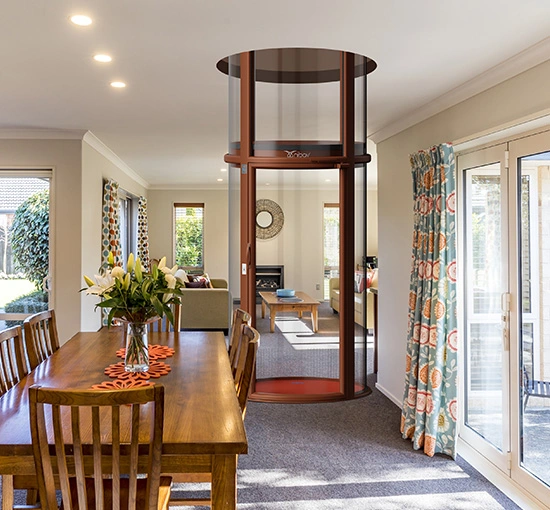
Air-driven elevators — also called pneumatic or vacuum elevators — use air pressure differentials to move the cabin inside a freestanding transparent cylinder. A vacuum pump reduces pressure above the cabin on ascent, and the higher pressure below pushes it upward. On descent, pressure equalises through a controlled valve — no pump required, no electricity consumed. The system is entirely self-contained within the cylinder. No pit. No machine room. No hydraulic fluid anywhere.
The Six Dimensions That Matter for a Malaysian Home
Installation requirements.
Hydraulic elevators require a pit excavation, a reinforced shaft, and a dedicated machine room. In most Malaysian residential properties, this means significant structural work, building permits for shaft construction, and months of disruption in an occupied home. Air-driven elevators require a flat floor surface and a single-phase electrical connection. Nibav’s full range installs in 4 to 5 working days with zero civil construction.
Space efficiency.
A hydraulic elevator’s true footprint includes the shaft walls, the pit below, and the machine room above or beside it. An air-driven elevator’s footprint is precisely the external diameter of its self-supporting cylinder. Nibav’s Series III Standard requires just 935mm of floor space. The Series V Max, the most spacious model in the range, requires 1,363mm externally while delivering 77% of that as a usable cabin interior.
Energy consumption.
Hydraulic systems consume electricity during both ascent and descent — the pump drives movement in both directions. Air-driven systems consume electricity only on ascent. The descent is powered by natural air pressure at zero electrical cost. For a household making 10 to 20 journeys daily over 15 years, the cumulative energy saving is material.
Maintenance complexity.
Hydraulic systems require regular oil checks, seal inspections for leak prevention, fluid changes, and machine room access for routine servicing. Air-driven systems — particularly Nibav’s grease-free range — require no lubrication, no fluid management, and no machine room. The Error Log System built into Nibav models records operational data continuously, enabling proactive diagnostics before issues become failures.
Safety systems.
Both technologies can be designed to meet high safety standards. Nibav’s air-driven range carries TÜV NORD certification and CE compliance across all models — the Series III Standard, Series III Max, Series IV Standard, Series IV Max, Series V Standard, and Series V Max — with automatic emergency descent, triple-layer door locking, Brake 3.0 dual-layer braking, and 30-minute auxiliary backup power as standard on every unit.
Relocatability.
A hydraulic elevator is permanently integrated into the building structure — it stays when you leave. A Nibav air-driven elevator is self-supporting and can be deinstalled and reinstalled in a new property. It moves with your family if you do.
Where Hydraulic Elevators Have a Legitimate Advantage
Hydraulic systems have been in use for longer and are well understood by a wider pool of technicians. In commercial or high-rise applications requiring very large cabin sizes or heavy-duty load capacities beyond residential specification, they remain a valid choice. For the residential Malaysian market, however, these advantages are largely theoretical — the practical installation requirements make them unsuitable for the majority of properties where an air-driven alternative installs cleanly and performs equivalently.
The Honest Conclusion
For Malaysian residential use — terrace houses, duplexes, villas, bungalows, multi-generational homes — the air-driven vacuum elevator wins on every practical dimension that affects a homeowner: installation simplicity, space efficiency, energy cost, maintenance complexity, and long-term flexibility. The hydraulic elevator’s advantages are most relevant in contexts that do not describe most Malaysian homes.
Frequently Asked Questions
1. What is the main difference between a hydraulic and an air-driven home elevator?
A hydraulic elevator uses pressurised fluid and an electric pump to raise and lower the cabin, requiring a pit, shaft, and machine room. An air-driven elevator uses air pressure differentials inside a freestanding transparent cylinder — requiring no pit, no machine room, and no structural modifications. The descent in an air-driven elevator costs zero electricity.
2. Which is cheaper to install in a Malaysian home?
Air-driven elevators are substantially cheaper to install in existing Malaysian residential properties. Nibav’s air-driven range starts at MYR 69,900 with no civil construction cost. Hydraulic elevator installations frequently cost MYR 150,000 to MYR 300,000 in construction alone before the unit price — making the total cost comparison unambiguous for most homeowners.
3. Which is safer — hydraulic or air-driven?
Both technologies can be designed to high safety standards. Nibav’s air-driven range eliminates several hydraulic failure modes entirely — no seals to rupture, no fluid to contaminate, no cables to fray — and carries TÜV NORD certification with CE compliance. The absence of a traditional shaft does not reduce safety; the safety architecture is built into the pneumatic system itself.
4. Which requires less maintenance over time?
Air-driven elevators require less maintenance than hydraulic systems for residential use. No seal checks, no fluid management, and no machine room servicing. Nibav’s grease-free design further reduces maintenance requirements, and the CoreShield 25-year warranty on Series V models covers the motor and vacuum seal entirely.
5. Can an air-driven elevator match the capacity of a hydraulic lift?
For residential applications, yes. Nibav’s Series III Max, Series IV Max, and Series V Max all support 240kg — sufficient for a wheelchair user with an attendant, or three standing adults. For the capacity ranges relevant to Malaysian residential use, an air-driven elevator provides equivalent performance with fewer installation requirements.
6. Can a hydraulic elevator be installed in an existing Malaysian home without major renovation?
In most cases, no. Hydraulic elevators require pit excavation, shaft construction, and a machine room — each of which requires structural work, building permits, and significant disruption in an occupied property. This is the primary reason air-driven pitless elevators have become the dominant residential choice in Malaysian retrofit installations.